
'He needs to control his foot soldiers by taking either stern action against the over enthusiastic members of his group or convince them to stop causing him this embarrassment.' 'We know that most of these leaders are not going to be prosecuted by Indian authorities. So we are seeking alternate means to bring them to justice,' FIACONA President John Prabhudoss tells Aziz Haniffa/Rediff.com

The Delhi Police, which has registered a case of murder in the mysterious death of Sunanda Pushkar, will send her viscera samples to a laboratory either in Britain or the US to identify the poison including whether it could be radioactive isotopes that cannot be detected in Indian labs.

Jasmit Singh, 85, recalls a horrific train journey to New Delhi on the day Indira Gandhi was killed.

A glance back at some important events that occurred in 2018.

Is North Korea really dismantling its nuclear programme? Rajaram Panda explains the many challenges to denuclearise the Korean Peninsula.

'The media today is completely free from the government-induced fear factor.' 'It is only scared of the public backlash and its TRP ratings,' say Sudhir Bisht.

Investigators in the sensational Sheena Bora murder case are not ruling out the "honour killing" angle after it came to light that both Peter Mukherjea and main accused Indrani allegedly disapproved of the "relationship" between his son Rahul and the victim.

King Salman and Narendra Modi will find common ground to intensify cooperation against jihadi terrorism, says Tarun Vijay, MP.
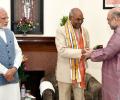
BJP claimed close to 116 lawmakers from rival parties appeared to have voted for Kovind.

Here is the full text of the joint statement issued by India and the US.
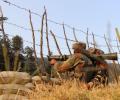
'India has to understand that the permanent state of war that exists between India and Pakistan has to be expected,,' says Colonel Anil A Athale (retd). 'The only way to ensure peace or absence of war is to maintain a militarily-dominant position over Pakistan.'

'An operation such as the Mumbai attacks, which needed expert technical assessment, money and time to prepare, could not have been carried out without the knowledge of the ISI's leadership.'

The Sheena Bora murder mystery has seen more twists in a day than a television sitcom. As skeletons tumble out, a mighty media baron and his glamorous wife have become the centre of a media storm.

Notwithstanding its public denouncements against US' "unilateral" drone attacks, Pakistan approved the controversial strikes by the CIA for years under a secret deal with America, a damning media report said on Thursday.

In a major clampdown for non-compliance of Listing Agreement, top exchanges BSE and NSE announced suspension of trading in shares of Kingfisher Airlines and another group firm, UB Engineering, from next month.
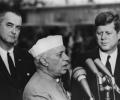
As Prime Minister Narendra Modi begins his historic visit of the United States of America, here's a look at some landmark visits by Indian prime ministers to the United States of America.

The Congress has asked Prime Minister Narendra Modi to take up the issue of former IPL chairman Lalit Modi's deportation during his ongoing visit to UK and to ensure that the "fugitive" and "black money exporter" is brought back.

To unravel Khan's overseas business, one has to rewind to 10 years ago when Londoner Richard James Moore floated a real estate company called Winford Estates in Surrey.

Acquitting a rape convict, the Bombay high court has held that it would not amount to rape if the consent of the girl in a sexual relationship with her partner was voluntary.

The IPL has produced more controversies in its short lifespan than any other sporting league in history.
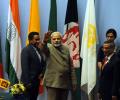
'If his three priorities are the economy, the economy, the economy, then there is need for a stable region, a stable neighbourhood.'

We are surrounded by food that is contaminated, adulterated and does not meet Indian safety and packaging standards, says Abheet Singh Sethi/IndiaSpend.com.

A prominent lawmaker of the opposition Bangladesh National Party was on Tuesday sentenced to death by a special Bangladeshi tribunal for genocide during the country's 1971 liberation war against Pakistan, becoming the first Member of Parliament and seventh person to be convicted of crimes against humanity.

Punishing brand ambassadors shows that the government is only interested in going after the low hanging fruit, says Tanmaya Nanda.
'Patriotism is like love: When it has to be enforced, it isn't real.' 'And the enforcement of a homogeneous view of love for the country is a particularly divisive feature that has ripped apart societies throughout history.'

A look at few gurus who have attracted controversy in recent times.

The onus is on companies to put in place a vigil mechanism to detect and deter fraud.

'The real test will be in defence-related deals, for instance the Javelin anti-tank missile: Is the US willing to co-develop something with India, on terms that will support the 'Make in India' initiative? Is there defence technology transfer? Or will it dump old junk on India?' asks Rajeev Srinivasan.

'The Senators were playing safe, not angering either the pro-India lobby or the pro-Pakistan lobby, but perhaps more importantly, the military-industrial complex -- the most powerful lobby of all -- which the majority of Senators are beholden to in terms of largesse to their campaign coffers.'

'The book has immense value because it reveals the inner workings of the think-tank which appears to provide facts and insights to Modi, though he himself takes the final decisions and articulates them in his characteristic rhetorical style,' says Ambassador T P Sreenivasan.

'Criticism that Amnesty is interested in those in favour of independence for Kashmir is unfounded.'

Singh said the terrorists snuck in from the Ravi river.

'Defaulters like Mallya can't be offloaded, but activists like me are. And that too for raising questions.' 'Today, what is the meaning of development?' 'Take over land, water and forest from the Adivasis and hand it over to corporates.' 'I am surprised how a minister who is supposed to protect the forests and the environment is happy reaching out to investors for more and more clearances.'

India can stay relevant in Afghanistan not by being a bystander but by actively bolstering anti-Taliban forces monetarily, militarily and politically, say Lt Gen R K Sawhney and Sushant Sareen

'The government, supposedly manned by wise and experienced officers, was all at sea, unable to act cohesively, and with restraint. Each agency was out to score brownie points.'

'A close look at the time-lines tells you that exactly as the back-channel negotiations were in their most crucial stage, "somebody" was planning the 26/11 attacks in Mumbai,' says Shekhar Gupta questioning Khurshid Mahmud Kasuri's account of a peace deal with India.
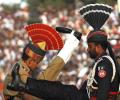
'Despite Modi's high-flown rhetoric about good-neighbourly relationships in South Asia, he lacks a road map how to proceed -- be it with Bangladesh or with Sri Lanka and Pakistan... But a deeper question arises here: Did he duck on his own accord or under the diktat from the RSS, asks Ambassador M K Bhadrakumar.


'His negotiations with Idi Amin and his men for compensation for the Indians, who left Uganda, were particularly tough. Apparently, Amin warned him that the body of the British negotiator, who came earlier, was found in a roadside gutter... As Jagat Mehta's special assistant during the last two years of his tenure as foreign secretary, I saw for myself how his conviction, courage and patriotism enabled him to fight against heavy odds, says Ambassador T P Sreenivasan.

'Clearly, the Modi government is proving to be far more willing than any previous government in Delhi to hitch India's wagons with the US' regional strategies.'
